Work that shipped
Three builds that show the range: an agent that writes apps, an assistant that runs a company, and a platform that takes real traffic.
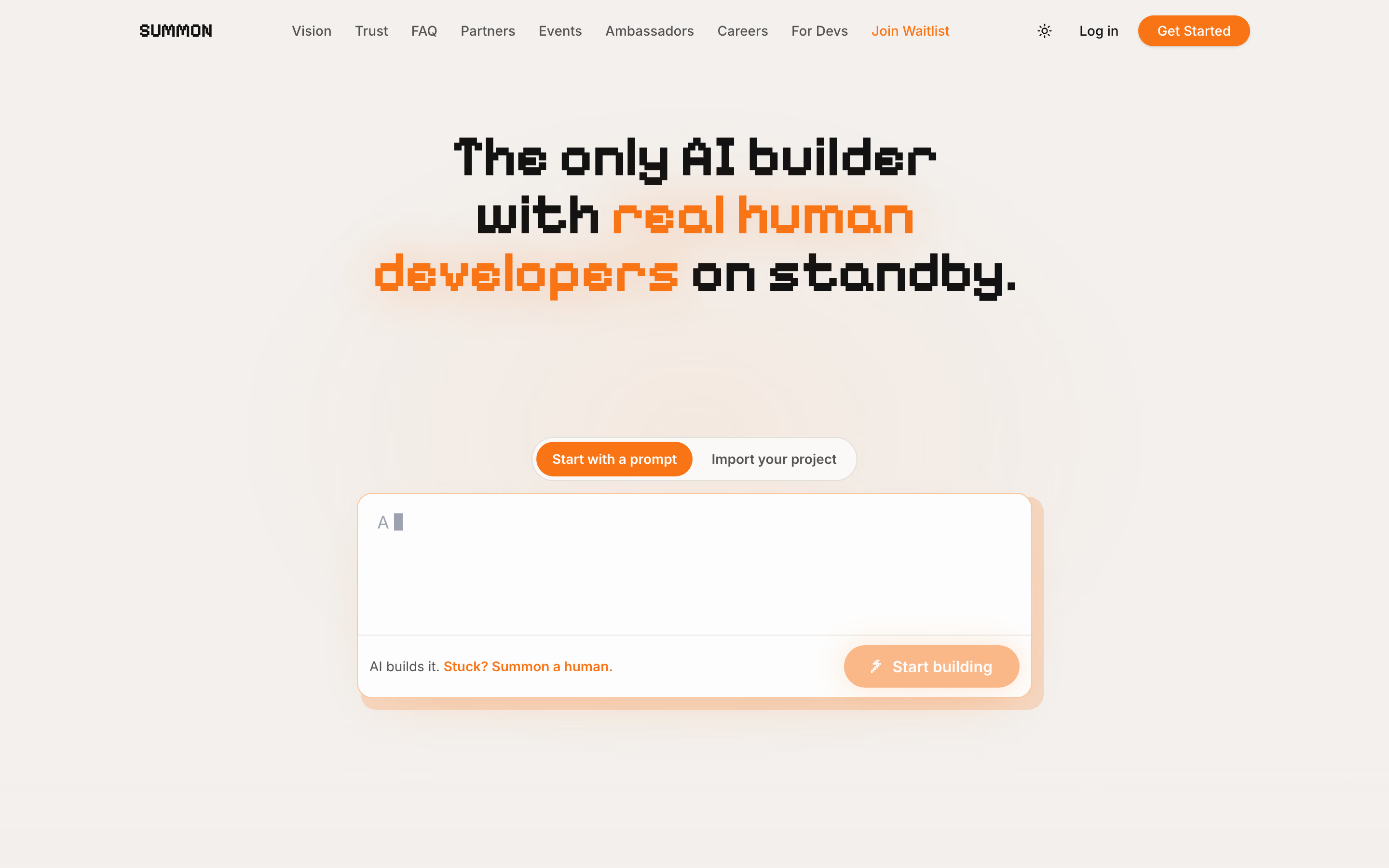
Summon.dev
An AI builder that turns a business idea into a working app — with real developers on standby inside the same workspace.
Prompt-to-app tools get founders to a prototype fast, then leave them stranded the moment something needs a human: a bug the model can't see, a deploy, a feature that touches real data. At that point most people give up or start over with an agency.
I lead the generation flow at the centre of the product: the model writes the app, automated checks verify it, and the code lands in a GitHub repo the user owns. When they get stuck, they summon a developer who appears in the same browser-native workspace — live preview, terminal and editor — and picks up exactly where the AI left off. Getting that preview to feel instant meant testing three infrastructures (Coolify, WebContainers, Nodepod) before choosing one.
TypeScript, LLM orchestration, WebContainers, GitHub API
Visit project(opens in a new tab)summon.dev
CHARMS remote patient monitoring
Readings from patients' home devices, turned into a daily worklist for U.S. clinics.
Blood-pressure cuffs, glucose meters and scales were sending readings faster than practice staff could review them. Everything arrived in one stream, so a dangerous reading looked the same as a routine one until somebody opened it.
I built the parts that turn that stream into decisions: role-based dashboards where a nurse sees only her patients and the readings that need action, the PDF reporting service practices use for billing and compliance, and the calling and notification services that reach patients when a reading is out of range. Each is its own service on AWS, so a reporting spike never slows down alerts.
Angular, NestJS, Prisma, MySQL, AWS
Company knowledge assistant
An assistant that answers staff questions from a company's own documents and records — and shows where the answer came from.
A services business had years of procedures, contracts and job records spread across shared drives and a database. Finding an answer meant asking whoever had been there longest, and their answers were often out of date.
I built a retrieval pipeline over the documents and the database, with an agent that could not only answer but update a record in the tools staff already used. Every answer cites its source, so people learned to trust it. The part the owner valued most was unplanned: a dashboard of what staff asked most often, which pointed straight at the procedures nobody could find and the ones that no longer matched how the work was done.
Python, Embeddings, PostgreSQL, LLM APIs